
Currently Empty: R0.00

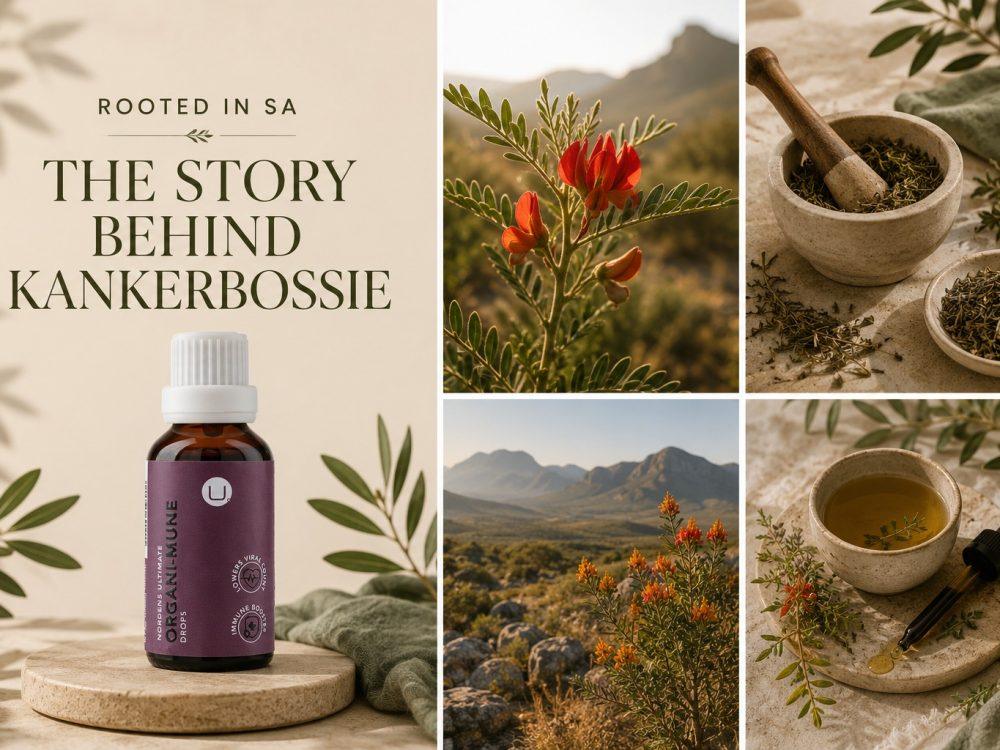
There are plants that get discovered. And then there are plants that were never lost to begin with — because the people who knew them never stopped using them.
Kankerbossie is one of those plants.
Long before it appeared in health shops or supplement formulations, Sutherlandia frutescens was a staple of traditional medicine across southern Africa. The first written records about its use came from Dutch colonists in the Cape, who encountered the plant through interaction with the indigenous people they met — people who had already been using it for generations. That knowledge didn’t disappear. Today, Sutherlandia is still one of the most commonly used medicinal plants in the Western Cape, and is sold in muthi markets and amayeza medicine shops across the country. (Feelgood Health, NCBI)
What Is Kankerbossie?
Sutherlandia frutescens is a 1.2 metre leguminous shrub with fine compound leaves and distinctive red butterfly-shaped flowers that bloom from July to December. It is drought-resistant and grows across the Western, Eastern and Northern Cape provinces, as well as parts of KwaZulu-Natal. It is one of six species confined to South Africa, and its chemical and genetic makeup varies depending on where it grows. (South Africa Online)
The plant has more than 25 recorded names — a telling sign of how widely it has been known and used across different communities and languages. In Afrikaans it is kankerbossie or kankerbos. In isiXhosa and isiZulu it is known as umnwele or unwele. In Tswana, it is called Phetola — meaning “it changes” — which may speak to the range of conditions it was believed to address. (Living Seeds)
How It Was Traditionally Used
The original inhabitants of the Cape — the Khoisan and Nama people — used decoctions made from Sutherlandia to wash wounds and bring down fevers. Over time its applications broadened considerably. (NCBI)
Traditionally, all parts of the plant were used to prepare remedies depending on the condition being treated. Infusions from the leaves and stems were used to treat liver, kidney and stomach ailments. Dried and powdered plant parts steeped in hot water were used to stimulate appetite and address wasting, and the plant was also used in the treatment of mental and emotional stress, including anxiety and depression. (South Africa Online)
Its use spans a wide range of conditions — from immune support and chronic fatigue to chest conditions, influenza and general wellbeing. This breadth is part of why it earned a reputation as something of a cure-all in traditional practice. (Feelgood Health)
Meet Its Companion: Leonotis Leonurus
Kankerbossie doesn’t stand alone in South Africa’s botanical heritage. Leonotis leonurus — known as wild dagga or Lion’s Ear — is a robust shrub, often reaching two metres in height, with velvety stems and clusters of striking orange flowers that attract sunbirds, bees and butterflies. It thrives on rocky hillsides, riverbanks and grassland edges across southern Africa. (Lomond Wine Estate)
It is a very important traditional medicinal plant with a naturally wide distribution across large parts of South Africa. Decoctions of the leaves, flowers, stems and roots have been used to treat conditions including high blood pressure, asthma, influenza and bronchitis, and it is applied externally to treat skin conditions, eczema, boils and muscular pains. (The Gardener)
Infusions made from its flowers, seeds, leaves and stems are also widely used to treat muscle cramps, viral hepatitis and diabetes. Like Kankerbossie, it has deep roots in the traditional healing practices of multiple South African communities. (Fynboscorridors)
Why These Plants Still Matter
What’s remarkable about both of these plants isn’t just their history — it’s that modern research keeps circling back to what traditional healers already knew. Lab studies suggest Sutherlandia has antibacterial, antiviral and antifungal effects, lending scientific weight to centuries of traditional use. (Memorial Sloan Kettering Cancer Center)
South Africa has one of the richest botanical heritages on earth. These plants grew here, were understood here, and have been used here for generations. There’s something worth honouring in that — and something worth paying attention to.
Both Sutherlandia frutescens and Leonotis leonurus form the foundation of Nordens Ultimate Organi-Mune, a herbal tincture that brings together these two South African botanicals in a formulation designed to support immune defences and promote general wellbeing.
Rooted in tradition. Made for today.
This product is a food supplement and is not intended to diagnose, treat, cure, or prevent any disease. Consult your healthcare practitioner before use if you are pregnant, nursing, taking chronic medication, or have a medical condition.
